
Skip to content

Dionaea muscipula 'Scarlet Bristle'

Venus Flytrap
Availability:
Out of stock
Sold out
Original price £9.99 - Original price £9.99
Original price
£9.99
£9.99 - £9.99
Current price £9.99
Supplied in a 9cm Pot

You’ll receive one established division growing in a 9cm pot with soil perfect for Venus flytraps. Plant size and seasonal appearance will vary; photos show our mother plants.

Seasonal Information

Dionaea are perennial plants. Heading into Winter, the Venus flytraps may have very few traps when purchased. Don't worry, they'll be back in the Spring!

Delivery Information

Delivery from £4.99 (mainland UK). We aim to dispatch orders within 2 working days.

Plant Description

Dionaea muscipula 'Scarlet Bristle' is a distinctive Venus flytrap discovered by Richard Keen in Canada. The plant appeared during tissue culture propagation of typical Venus flytraps in his laboratory. It stood out immediately due to its unusual trap structure and deep red colour.

The plant grows low to the ground in all seasons. The leaves remain short and lie close to the surface of the growing medium. This gives Dionaea muscipula 'Scarlet Bristle' a compact and spreading habit rather than the upright form seen in many other cultivars.

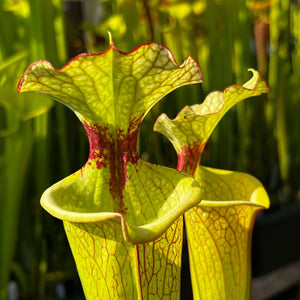
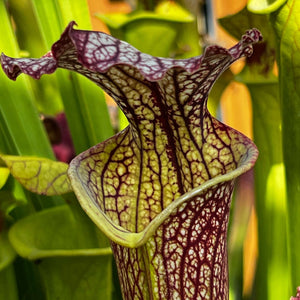
Colour is a key feature. The leaf blades and traps develop strong scarlet to burgundy tones when grown in filtered sunlight. Many plants maintain this red colour across most of the trap surface rather than only inside the trap.

The trap margins are very unusual. The marginal cilia are short, irregular, and heavily reduced. They lack the long hairlike tips seen on standard Venus flytraps. This creates a rough edge around the trap lobes that looks coarse and bristly. The structure differs clearly from dentate forms such as Dionaea muscipula 'Shark Tooth' and also from cultivars like Dionaea muscipula 'Red Piranha'.

Dionaea muscipula 'Scarlet Bristle' also shows an uncommon feature in the trigger hairs. As the traps age, the upper portion of the trichomes develops thick, bristly growth. On mature traps, this growth becomes easy to see with the naked eye. The shape can resemble a spear tip or the end of a small bottle brush.

This added growth on the trigger hairs does not appear to change how the trap works.

Plant photos above are of our Dionaea muscipula 'Scarlet Bristle' mother plants. Divisions are taken from the mother plants and are planted into 9cm pots to be sold. Division sizes can vary greatly and will always be sent largest first. If you'd like to know the size of a plant before ordering, please feel free to contact us.

Dionaea Muscipula Scarlet Bristle

Basic Dionaea Care

Dionaea muscipula 'Scarlet Bristle' is easy to care for, given the correct conditions. An unheated greenhouse is an ideal location. Here are the 3 golden rules for healthy Venus flytraps.

  1. Provide as much sun as possible.
  2. Keep their pots sat in 1-2cm of rainwater.
  3. Use acidic soil. A 1:1 peat moss & perlite mix is typical.

Take a look at our full, in-depth guide for more information.

FAQs

What compost/ soil should I use for Venus flytraps?

Use a low-nutrient carnivorous plant mix such as peat and perlite, or peat and silica sand (not builders’ sand). Avoid multi-purpose compost, garden soil, and anything with fertiliser added; these can burn the roots. If you prefer peat-free options, choose a carnivorous-plant-safe mix specifically formulated for these plants (test with one plant before using on your entire collection). Repotting into a fresh mix every year helps keep plants vigorous.

Do Venus flytraps need winter dormancy in the UK?

Yes. Dionaea are temperate carnivorous plants and naturally go dormant in winter. In the UK, dormancy usually happens outdoors without intervention as days shorten and temperatures drop. During dormancy, growth slows or stops, and older traps may turn black and shrivel up; that’s normal. Keep the plant outside in a bright, airy spot, keep the compost damp (not waterlogged), and avoid keeping it warm indoors over winter. Dormancy is important for long-term health and strong growth in spring.

Can Venus flytraps live outside all year in the UK?

In most of the UK, yes, Dionaea are generally well-suited to outdoor growing. They can handle typical UK winter conditions while dormant. An unheated greenhouse will provide your plants with a longer growing season, though. Cultivars that are heavily deformed or delicate often do better in a greenhouse.

Do I need to use rainwater for Venus flytraps?

Rainwater is strongly recommended. Like most carnivorous plants, Dionaea can't tolerate minerals and salts that can build up in compost over time. Use rainwater, distilled water, or reverse-osmosis (RO) water whenever possible. If you’re stuck, some UK tap water is low enough in dissolved minerals to use occasionally, but long-term it can lead to slow growth and a gradual decline. When in doubt, rainwater is safest.

Do Venus flytraps need full sun?

Full sun is ideal. In a bright greenhouse or outdoors in a sunny position, you’ll get better colour, larger traps, and stronger growth. A little light shade is usually fine, but too much shade often causes weaker, greener growth and fewer traps. If you’re growing on a balcony, patio, or in a bog planter, choose the brightest spot you have.