
WhatsApp
Send us a message
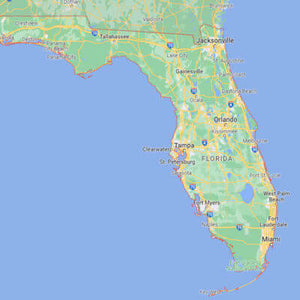
A selection of Sarracenia plants, or their seeds, that originated from the state of Florida in the United States. Location data is essential for helping collectors be a vital store of regional Sarracenia genetics, particularly where natural habitats are endangered or have already been destroyed.
Florida, especially the north, provides natural habitats to Sarracenia flava, Sarracenia leucophylla, Sarracenia minor, Sarracenia psittacina, Sarracenia rubra and Sarracenia rosea (Sarracenia purpurea subsp. venosa var. burkii).
Sarracenia × moorei 'Santa Rosa Big Mouth' from Santa Rosa County, Florida, is a tall plant with pitchers that often reach 70 to 80 cm. The name fi...
View full detailsSarracenia 'Adrian Slack' is a carnivorous plant named in tribute to the renowned Sarracenia grower, Adrian Slack. Although the exact parentage of ...
View full detailsSarracenia flava var. rubricorpora F25 (Apalachicola National Forest, Florida) is a selected red tube form from one of the most famous Sarracenia r...
View full detailsA cross of Sarracenia flava plants from two different sites in Florida: Blackwater and Wewahitchka. The seeds that produced this clone were origina...
View full detailsOriginally from the national collection of Paul & Jackie Gardner of P&J Plants (F RUG 01) this is a fantastic cut-throat Sarracenia flava! ...
View full detailsSarracenia 'Leah Wilkerson' is a naturally occurring hybrid that was found in a bog on private property in Walton County, Florida. This Sarracenia ...
View full detailsA nice-sized, attractive Sarracenia × moorei showing characteristics of both parents. The flower is a beautiful two-toned colour, taking more influ...
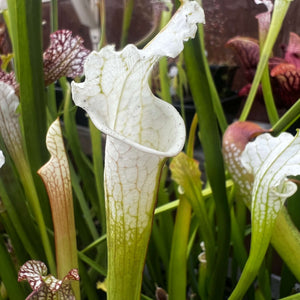
View full detailsSarracenia leucophylla 'Mont Blanc' started out as a batch of seed collected in Walton County, Florida, by George Mac Kay. Thibault Barin sowed the...
View full details
 Sold out
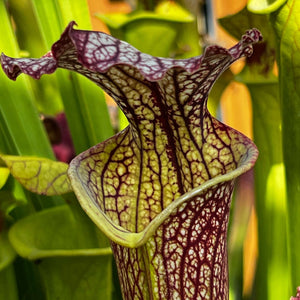
Sarracenia flava var. ornata - Maroon Throat (Apalachicola National Forest, Florida) MK-F88
Sold out
Sarracenia flava var. ornata - Maroon Throat (Apalachicola National Forest, Florida) MK-F88
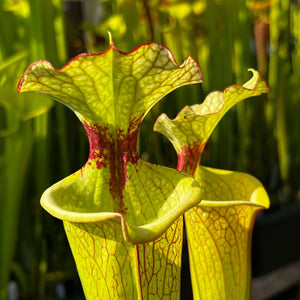
Arguably one of the best Sarracenia flava var. ornata available. This is a sturdy, vigorous Sarracenia flava with strong colouration making it a st...
View full detailsSarracenia leucophylla var. leucophylla - Purple & White Giant (Rt71, Altha, Calhoun County, Florida)
Sarracenia flava var. atropurpurea (Santa Rosa Beach, Walton County, Florida) is a dark, heavily pigmented form selected from the Florida panhandle...
View full detailsThis Sarracenia purpurea subsp. venosa var. burkii (Sarracenia rosea) from Bay County, North Florida, is a large-growing Gulf Coast form with a cle...
View full detailsSarracenia psittacina var. psittacina f. viridescens (Wewahitchka, Gulf County, Florida) is an unusual anthocyanin-free form of the parrot pitcher ...
View full detailsMK-RG6
Sarracenia leucophylla - Green & White (Milton County, Florida) MS-SL127
Sarracenia flava var. rugelii (Milton County, Florida) MK-F53
Sarracenia flava var. ornata 'Outlaw' is a distinct clone from a specific, threatened locality in western Bay County, Florida. Its origin separates...
View full detailsSarracenia flava var. ornata (Wewahitchka, Florida)
Sarracenia flava var. atropurpurea (Blackwater, Florida)
Sarracenia × moorei H406 is a selected Gulf Coast form raised from seed originating near Milton, Florida. As a Sarracenia × moorei, it represents t...
View full detailsMK-F149
MK-F27B
Sarracenia psittacina var. okefenokeensis f. luteoviridis (Sandy Creek Road, Bay County, Florida)
MK-H71O, JS-H84