
WhatsApp
Send us a message
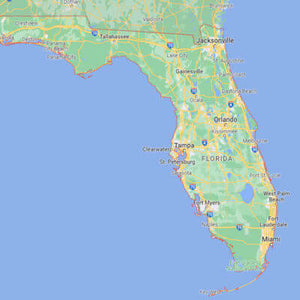
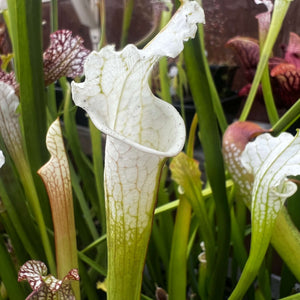
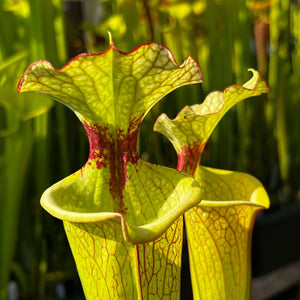
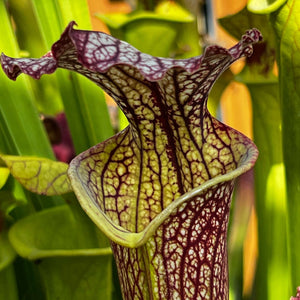
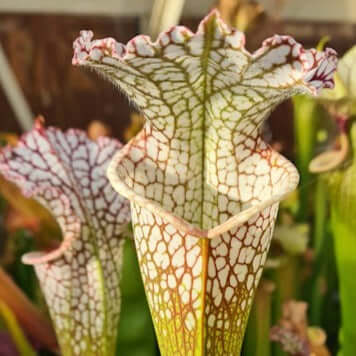
Sarracenia × moorei is a naturally occurring hybrid of Sarracenia flava and Sarracenia leucophylla. Due to the variation within both parent species, Sarracenia × moorei displays a vast array of colours and body shapes making it a favourite amongst collectors and hobbyists.
Two of the most famous Sarracenia hybrids, 'Leah Wilkerson' and 'Adrian Slack', are both registered cultivars of Sarracenia × moorei collected from the wild.
Sarracenia × moorei 'Santa Rosa Big Mouth' from Santa Rosa County, Florida, is a tall plant with pitchers that often reach 70 to 80 cm. The name fi...
View full detailsSarracenia 'Adrian Slack' is a carnivorous plant named in tribute to the renowned Sarracenia grower, Adrian Slack. Although the exact parentage of ...
View full detailsSarracenia × moorei (MK-F117 × MK-L20a) is a cross between Sarracenia flava var. rugelii (Milton, Florida) and a tall, red-lipped Sarracenia leucop...
View full detailsSarracenia × moorei (flava 'Maxima' × leucophylla) is a hybrid that combines the bright, anthocyanin-lacking characteristics of Sarracenia flava 'M...
View full detailsSarracenia 'Leah Wilkerson' is a naturally occurring hybrid that was found in a bog on private property in Walton County, Florida. This Sarracenia ...
View full detailsThis Sarracenia × moorei (Sarracenia flava X Sarracenia leucophylla) was selected and grown by renowned carnivorous plant grower Ian Salter in Wale...
View full detailsBrook's Hybrid, or to give it its full name, Sarracenia × moorei 'Brooks Hybrid', is a hybrid of Sarracenia flava and Sarracenia leucophylla. It is...
View full detailsA nice-sized, attractive Sarracenia × moorei showing characteristics of both parents. The flower is a beautiful two-toned colour, taking more influ...
View full detailsSarracenia × moorei - Ian Salter MK-H135
Sarracenia × moorei H404 (Pensacola Field, Florida) is a seed-grown selected Sarracenia × moorei by Matt Soper, and it's a beauty! Grown from seed ...
View full detailsSarracenia × moorei 'Leah Wilkerson F2' (Laurent) is a selfed form of the well-known Sarracenia × moorei 'Leah Wilkerson'. This clone, selected by ...
View full detailsMK-H258
MK-H225
MK-H425
Sarracenia × moorei Red, Very Large IP-X95 is a selected Sarracenia × moorei, a cross between Sarracenia flava and Sarracenia leucophylla. As its d...
View full detailsSarracenia × moorei 'Praetorian Guard' is a stunning, all-red Sarracenia × moorei produced by the Sarracenia national collection holder Mike King i...
View full detailsSarracenia × moorei 'Monster'
Sarracenia × moorei - Mike King Unknown 2021 A
MK-H394
Sarracenia 'Leviathan' stands out as a truly impressive specimen of Sarracenia × moorei. The tallest pitchers observed in various divisions of thi...
View full detailsSarracenia × moorei 'Joanna' is a beautiful Sarracenia hybrid combining Sarracenia flava var. rugelii with Sarracenia leucophylla to make a . Creat...
View full detailsMK-H182
MK-H71O, JS-H84
MK-H384a