
Skip to content

Sarracenia psittacina var. psittacina f. viridescens (Wewahitchka, Gulf County, Florida)

North American Pitcher Plant
Availability:
Out of stock
Sold out
Original price £13.99 - Original price £13.99
Original price
£13.99
£13.99 - £13.99
Current price £13.99
Supplied in a 9cm Pot

You’ll receive one established division growing in a 9cm pot with soil perfect for Sarracenia. Plant size and seasonal appearance will vary; photos show our mother plants.

Seasonal Information

30.07.26 - Many Sarracenia species and hybrids are starting to lose their early pitchers, which may now be removed before shipping

Delivery Information

Delivery from £4.99 (mainland UK). We aim to dispatch orders within 2 working days.

Description of Sarracenia psittacina var. psittacina f. viridescens (Wewahitchka, Gulf County, Florida)

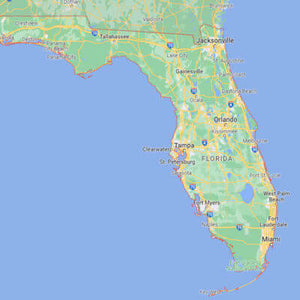
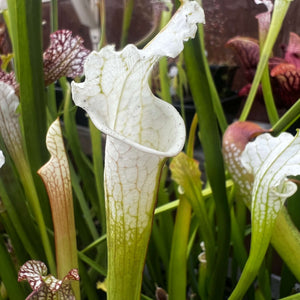
Sarracenia psittacina var. psittacina f. viridescens (Wewahitchka, Gulf County, Florida) is an unusual anthocyanin-free form of the parrot pitcher plant. Originating from the Florida Panhandle, this location form lacks the red and purple pigments normally found in Sarracenia psittacina, producing entirely green pitchers with pale, translucent windows.

The plant forms a low, spreading rosette, with numerous pitchers growing horizontally from the rhizome. Each trap consists of a long, narrow tube that expands into a swollen, curved hood. The small entrance sits beneath the hood rather than at the top of the pitcher, giving the plant its characteristic parrot-like appearance.

Fresh pitchers develop bright lime-green to yellow-green colouring, which remains consistent even under strong sunlight. Unlike typical forms, the traps do not develop the red veining or darker pigmentation commonly seen across the hood and upper tube.

Pale white to cream-coloured areoles cover the swollen ends of the pitchers. These translucent windows form an irregular pattern against the green background, becoming particularly noticeable on mature traps. The surrounding veins remain green, creating a much softer pattern than the heavily red-veined forms of the species.

Like other Sarracenia psittacina, this form is adapted to growing in wet conditions and can capture small aquatic prey when submerged.

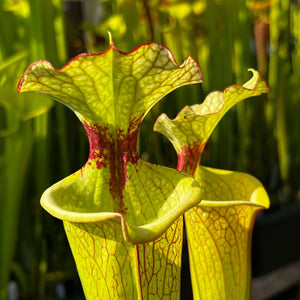
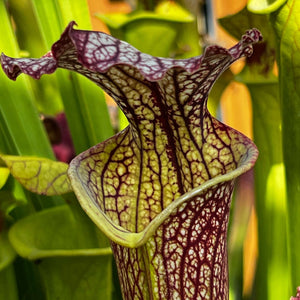
Plant photos above are of our Sarracenia psittacina var. psittacina f. viridescens (Wewahitchka, Gulf County, Florida) mother plants. Divisions are taken from the mother plants and are planted into 9cm pots to be sold. Division sizes can vary greatly and will always be sent largest first. If you'd like to know the size of a plant before ordering, please feel free to contact us.

Sarracenia Psittacina Var. F. Viridescens (Wewahitchka Gulf County Florida)

Basic Sarracenia Care

Sarracenia psittacina var. psittacina f. viridescens (Wewahitchka, Gulf County, Florida) is easy to care for, given the correct conditions. An unheated greenhouse is an ideal location. Here are the 3 golden rules for healthy Sarracenia pitcher plants.

  1. Provide as much sun as possible.
  2. Keep their pots sat in 1-2cm of rainwater.
  3. Use acidic soil. A 1:1 peat moss & perlite mix is typical.

Take a look at our full, in-depth guide for more information.

FAQs

Can I grow Sarracenia outdoors in the UK?

Yes, most Sarracenia species are fully frost-tolerant and can live outside all year round in UK gardens, bog gardens, or patio pots. Species such as leucophylla and psittacina can be more sensitive and usually fare better in an unheated greenhouse.

How do I water Sarracenia?
  • March–October: Stand the plant pot in a saucer or tray containing 1 to 3 cm of rainwater (or more when the weather's really warm). The soil should never be allowed to dry out.
  • November–February: Keep the soil just damp, reducing the standing water significantly while they rest.
Can I use tapwater for Sarracenia?

No, unless you live in a very soft water area (<50ppm) do not use tapwater. Regular tap water contains minerals, lime, and chlorine that burn and kill the roots over time.
Always use collected rainwater, distilled water, or reverse-osmosis (RO) water.

Do Sarracenia need winter dormancy?

Yes, Sarracenia need a cold winter rest period (roughly from Halloween to Valentine's Day) with lower temperatures (unheated greenhouses, cold frames, or bright sheds). Their old pitchers will turn brown and die back; this is completely natural. Trim away dead growth in late winter to prevent mould (botrytis).

Read more here: How to Keep Your Sarracenia Healthy Through Winter Dormancy

What kind of soil should I use for Sarracenia?

Use a specialist peat-free or low-nutrient carnivorous plant compost, typically mixed with perlite or equivalent for drainage. Never use standard multi-purpose garden compost, which contains too many nutrients.

Read more here: Sarracenia Soil Mix Guide: Simple Pitcher Plant Soil for Beginners