
Skip to content
Next carnivorous plant dispatch date: 28th October

Dionaea muscipula 'Tiger Fangs'

Venus Flytrap
Availability:
New stock coming soon
Sold out
Original price £9.99 - Original price £9.99
Original price
£9.99
£9.99 - £9.99
Current price £9.99
Supplied in a 9cm Pot

You’ll receive one established division growing in a 9cm pot with soil perfect for Venus flytraps. Plant size and seasonal appearance will vary; photos show our mother plants.

Seasonal Information

Dionaea are perennial plants. Heading into Winter, the Venus flytraps may have very few traps when purchased. Don't worry, they'll be back in the Spring!

Delivery Information

Delivery from £4.99 (mainland UK). We aim to dispatch orders within 2 working days.

Plant Description

Dionaea muscipula 'Tiger Fangs' is a distinctive Venus flytrap cultivar created by Christian Klein in Germany in 2003 and later registered by Martin Stoeckl. It is best known for its unusual trap margins, where broad, triangular teeth replace the fine cilia found on a standard Venus flytrap.

The plant produces decumbent leaves that can reach around 8cm in length, with impressive traps growing up to 5cm across. Each trap is gently curved along the midrib and formed from broad, oval lobes. The most recognisable feature is the dentition. Instead of long, hair-like teeth, the trap margins are lined with wide triangular lashes that taper to sharp points, giving the appearance of a row of a predator's teeth.

The trap interior develops a rich reddish-purple colour under good light, creating a strong contrast against the yellowish green foliage. The triangular lashes often take on pinkish-red tones, while a thin red line runs around the outside of the trap just below the margins. This combination of colours makes the unusual trap shape stand out even more.

Dionaea muscipula 'Tiger Fangs' grows with a spreading habit, displaying its large traps clearly around the outside of the rosette. The broad, curved lobes and heavy triangular teeth give each trap a bold appearance that differs noticeably from sawtooth cultivars or forms with elongated cilia.

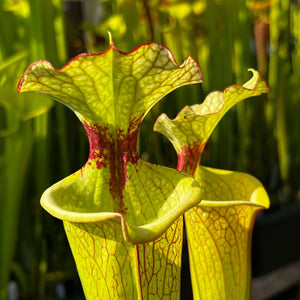
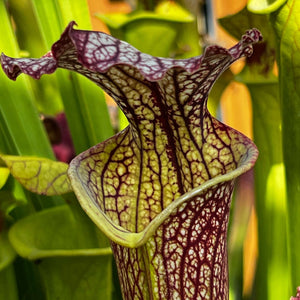
Plant photos above are of our Dionaea muscipula 'Tiger Fangs' mother plants. Divisions are taken from the mother plants and are planted into 9cm pots to be sold. Division sizes can vary greatly and will always be sent largest first. If you'd like to know the size of a plant before ordering, please feel free to contact us.

Dionaea Muscipula Tiger Fangs

Basic Dionaea Care

Dionaea muscipula 'Tiger Fangs' is easy to care for, given the correct conditions. An unheated greenhouse is an ideal location. Here are the 3 golden rules for healthy Venus flytraps.

  1. Provide as much sun as possible.
  2. Keep their pots sat in 1-2cm of rainwater.
  3. Use acidic soil. A 1:1 peat moss & perlite mix is typical.

Take a look at our full, in-depth guide for more information.

FAQs

What should I feed my Venus flytrap?

Nothing. You do not need to offer any additional food to a Venus flytrap. They will catch their own food, especially when kept outdoors or in an unheated greenhouse

How do I water Venus flytraps?
  • March–October: Stand the plant pot in a saucer or tray containing 1 to 2 cm of rainwater. The soil should never be allowed to dry out.
  • November–February: Keep the soil just damp, reducing the standing water significantly while they rest.
Can I use tapwater for Venus flytraps?

No, unless you live in a very soft water area (<50ppm) do not use tapwater. Regular tap water contains minerals, lime, and chlorine that burn and kill the roots over time.
Always use collected rainwater, distilled water, or reverse-osmosis (RO) water.

Do Venus flytraps need winter dormancy?

Yes, Dionaea need a cold winter rest period (roughly from Halloween to Valentine's Day) with lower temperatures (unheated greenhouses, cold frames, or bright sheds). Their old traps will turn brown and die back; this is completely natural. Trim away dead growth to prevent mould (botrytis).

What kind of soil should I use for Venus flytraps?

Use a specialist peat-free or low-nutrient carnivorous plant compost, typically mixed with perlite or equivalent for drainage. Never use standard multi-purpose garden compost, which contains too many nutrients.