
WhatsApp
Send us a message
Sarracenia flava, also known as the yellow pitcher plant, has a large natural range that extends from southern Alabama to the coastal plains of southern Virginia, North Carolina and South Carolina.
There are several varieties of Sarracenia flava; Sarracenia flava var. atropurpurea, Sarracenia flava var. cuprea, Sarracenia flava var. flava, Sarracenia flava var. maxima, Sarracenia flava var. ornata, Sarracenia flava var. rubricorpora, Sarracenia flava var. rugelii and Sarracenia flava f. viridescens. Sarracenia flava is a robust species of Sarracenia and often fairs well outside in the UK.
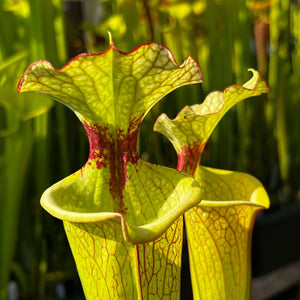
Sarracenia flava var. rubricorpora F25 (Apalachicola National Forest, Florida) is a selected red tube form from one of the most famous Sarracenia r...
View full detailsA cross of Sarracenia flava plants from two different sites in Florida: Blackwater and Wewahitchka. The seeds that produced this clone were origina...
View full detailsOriginally from the national collection of Paul & Jackie Gardner of P&J Plants (F RUG 01) this is a fantastic cut-throat Sarracenia flava! ...
View full detailsSarracenia flava var. atropurpurea (Santa Rosa Beach, Walton County, Florida) is a dark, heavily pigmented form selected from the Florida panhandle...
View full detailsJS-F130
Sarracenia flava var. rugelii (Blackwater National Park, Florida)
MK-F149
JS-F22, IP-F13
Sarracenia flava var. ornata (Sandy Creek Road, Bay County, Florida)
Sarracenia flava var. ornata 'Killer' is a distinct flava originating from a specific locality in Okaloosa County, Florida. Its genetic background ...
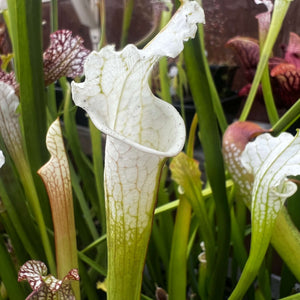
View full detailsThere aren't many anthocyanin-free (no red) forms of Sarracenia Flava in cultivation and this particular clone is a beauty.
MK-F27B
MS-F3
Sarracenia flava var. atropurpurea (Blackwater, Florida)
Sarracenia flava var. ornata (Wewahitchka, Florida)
Sarracenia flava var. ornata 'Outlaw' is a distinct clone from a specific, threatened locality in western Bay County, Florida. Its origin separates...
View full detailsSarracenia flava var. rugelii (Milton County, Florida) MK-F53
Sarracenia flava var. rubricorpora - Selfed Mike King Plant (Sumatra, Florida)

 Sold out
Sarracenia flava var. ornata - Maroon Throat (Apalachicola National Forest, Florida) MK-F88
Sold out
Sarracenia flava var. ornata - Maroon Throat (Apalachicola National Forest, Florida) MK-F88
Arguably one of the best Sarracenia flava var. ornata available. This is a sturdy, vigorous Sarracenia flava with strong colouration making it a st...
View full detailsJS-F35
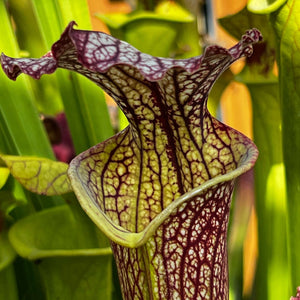
A nice example of a Sarracenia flava var. ornata from Florida. As per the varietal name 'ornata', this Sarracenia flava displays ornata red veins t...
View full details