
WhatsApp
Send us a message
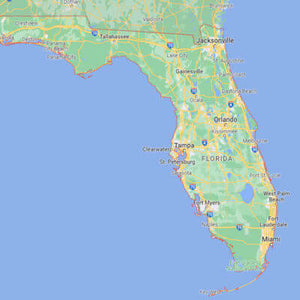
Sarracenia flava, also known as the yellow pitcher plant, has a large natural range that extends from southern Alabama to the coastal plains of southern Virginia, North Carolina and South Carolina.
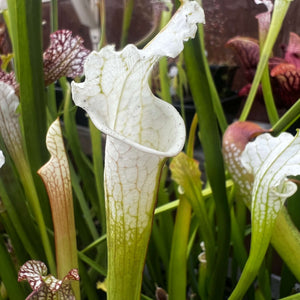
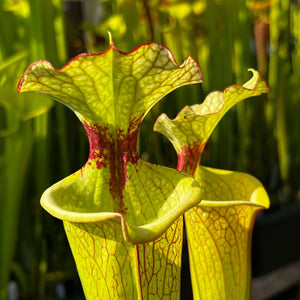
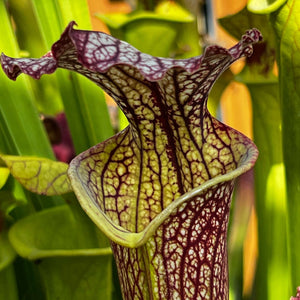
There are several varieties of Sarracenia flava; Sarracenia flava var. atropurpurea, Sarracenia flava var. cuprea, Sarracenia flava var. flava, Sarracenia flava var. maxima, Sarracenia flava var. ornata, Sarracenia flava var. rubricorpora, Sarracenia flava var. rugelii and Sarracenia flava f. viridescens. Sarracenia flava is a robust species of Sarracenia and often fairs well outside in the UK.
Introducing Sarracenia flava var. cuprea 'Lilian Cooper', a unique plant that boasts a veinless appearance, making it stand out from other varietie...
View full detailsSarracenia flava var. atropurpurea (Blackwater, Florida)
Sarracenia flava var. cuprea (Green Swamp, North Carolina)
Sarracenia flava var. maxima - Very Very Tall Form
Sarracenia flava var. ornata (Wewahitchka, Florida)
Sarracenia flava var. ornata MS-F221
Sarracenia flava var. ornata 'Outlaw' is a distinct clone from a specific, threatened locality in western Bay County, Florida. Its origin separates...
View full detailsSarracenia flava var. ornata 'Super Ornata'
Sarracenia flava var. rubricorpora
Sarracenia flava var. rubricorpora 'Manky'
Sarracenia flava var. rugelii (Milton County, Florida) MK-F53
Sarracenia flava var. rubricorpora - Selfed Mike King Plant (Sumatra, Florida)
Sarracenia flava var. cuprea 'Strained' produces pitchers that can hit the 1-metre mark and is regularly the largest Sarracenia in our collection! ...
View full detailsSarracenia flava f. viridescens 'Suspicion' is a well-known, all-green clone of Sarracenia flava that stands out in any collection. The only named ...
View full detailsIntroducing the famous Sarracenia flava 'Goldie', a must-have for any Sarracenia collector. This flava boasts bright golden-coloured pitchers that ...
View full detailsThis is one tall Sarracenia flava var. rugelii! Given time, this plant can reach up to 36" tall making it a very impressive Sarracenia for any coll...
View full details
 Sold out
Sarracenia flava var. ornata - Maroon Throat (Apalachicola National Forest, Florida) MK-F88
Sold out
Sarracenia flava var. ornata - Maroon Throat (Apalachicola National Forest, Florida) MK-F88
Arguably one of the best Sarracenia flava var. ornata available. This is a sturdy, vigorous Sarracenia flava with strong colouration making it a st...
View full detailsThis is a vigorous-growing clone of Sarracenia flava. One that has been growing outside in our garden for years. It's a good-looking flava showing ...
View full detailsCuprea translates from Latin to mean 'copper'. It's easy to see why this name has been given to this variety of Sarracenia flava, the operculum (li...
View full detailsJS-F35
A nice example of a Sarracenia flava var. ornata from Florida. As per the varietal name 'ornata', this Sarracenia flava displays ornata red veins t...
View full detailsA vigorous example of Sarracenia flava var. ornata from Virginia. The pitchers are the classic flava shape with generally fine red veination. For u...
View full detailsThis vigorous clone of Sarracenia flava is a great plant if you want an easy-to-grow, nice-sized, and hard-as-nails Sarracenia flava var. flava. Th...
View full details