
WhatsApp
Send us a message
Sarracenia 'Leviathan' stands out as a truly impressive specimen of Sarracenia × moorei. The tallest pitchers observed in various divisions of thi...
View full detailsMK-H234
MK-H169
MK-H182
An exquisite Sarracenia hybrid created by Alan Hindle and named after his wife Judith. Sarracenia 'Judith Hindle' was produced from the following c...
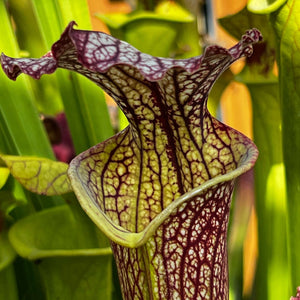
View full detailsThis is a fabulous Sarracenia oreophila. The title says it all; the lip and throat are red, and the pitchers are heavily veined! This is a strong-g...
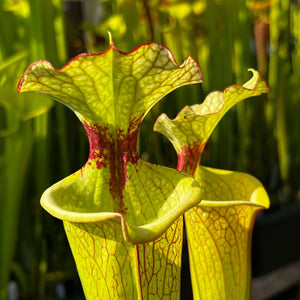
View full detailsThis is a vigorous-growing clone of Sarracenia flava. One that has been growing outside in our garden for years. It's a good-looking flava showing ...
View full detailsCreated by Matthew Soper in 1997, Sarracenia 'Juthatip Soper' is an attractive carnivorous plant with characteristic upright pitchers that are init...
View full detailsCuprea translates from Latin to mean 'copper'. It's easy to see why this name has been given to this variety of Sarracenia flava, the operculum (li...
View full detailsThis Sarracenia × catesbaei, originally from Nigel Hewitt-Cooper, is a selected form of the natural hybrid between Sarracenia flava and Sarracenia ...
View full detailsMK-O10
MK-H71O, JS-H84
MK-H378
MK-H384a
A stunning Sarracenia hybrid, arguably one of the best created and certainly one of our favourites! Sarracenia 'Iamsatyricon' was grown from seed i...
View full detailsMK-H192
Sarracenia 'God’s Gift' is a selected seedling from the complex hybrid Sarracenia × mitchelliana (Sarracenia leucophylla X Sarracenia purpurea veno...
View full detailsMK-H362
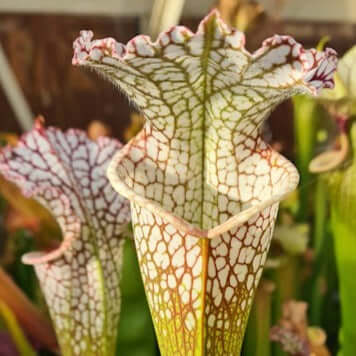
Although it has the appearance of a robust Sarracenia leucophylla, Sarracenia 'Giant Cotton' is actually a striking hybrid between Sarracenia leuco...
View full detailsJS-F130
MK-L34
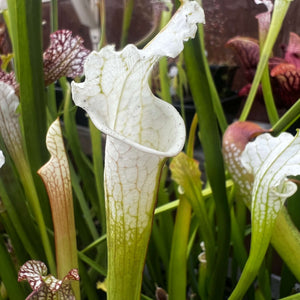
Sarracenia leucophylla var. alba White Top (Baldwin County, Alabama)
This plant is a rare, anthocyanin-free form of Sarracenia leucophylla. It originates from a specific location near Perdido in Alabama, USA. The 'vi...
View full detailsMK-L115