
Skip to content
Next carnivorous plant dispatch date: 28th October

Sarracenia 'Dixie Lace'

North American Pitcher Plant
Availability:
Out of stock
Sold out
Original price £10.99 - Original price £10.99
Original price
£10.99
£10.99 - £10.99
Current price £10.99
Supplied in a 9cm Pot

You’ll receive one established division growing in a 9cm pot with soil perfect for Sarracenia. Plant size and seasonal appearance will vary; photos show our mother plants.

Seasonal Information

30.07.26 - Many Sarracenia species and hybrids are starting to lose their early pitchers, which may now be removed before shipping

Delivery Information

Delivery from £4.99 (mainland UK). We aim to dispatch orders within 2 working days.

Description of Sarracenia 'Dixie Lace'

Sarracenia 'Dixie Lace' was created in 1993 at the University of North Carolina. One parent of this clone was a naturally occurring hybrid, known informally as 'Cotton Patch', which originated from a cross between Sarracenia leucophylla and S. rubra subsp. wherryi. The other parent of this clone resulted from the cross between Sarracenia psittacina and an unidentified partner, most likely S. purpurea.

'Dixie Lace' is a unique Sarracenia clone that stands out from the crowd. This remarkable clone rapidly forms a cluster of crowns and boasts an abundance of vibrant blooms throughout the growing season.

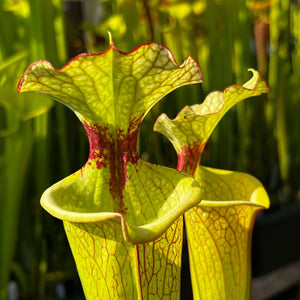
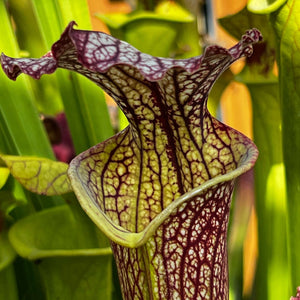
One of its defining characteristics is the hood, reminiscent of the S. psittacina species, which starts with a squared-off front and tightly sealed pitchers as they initially elongate. The pitcher tube gradually widens to over 4 cm below the hood. This tube's surface exhibits a rich maroon hue adorned with numerous white spots nestled amidst bold dark red veins. The hood itself displays a yellowish-green backdrop accentuated by prominent primary and smaller secondary veins. When given strong light, the hood takes on a golden tone. 

The name 'Dixie Lace' pays homage to the plant's genetic origins in the Deep South of the USA, where its parent species hail from, and the remarkable lace-like appearance of the reticulate vein pattern on its hood.

Plant photos above are of our Sarracenia 'Dixie Lace' mother plants. Divisions are taken from the mother plants and are planted into 9cm pots to be sold. Division sizes can vary greatly and will always be sent largest first. If you'd like to know the size of a plant before ordering, please feel free to contact us.

Sarracenia 'Dixie Lace'

Basic Sarracenia Care

Sarracenia 'Dixie Lace' is easy to care for, given the correct conditions. An unheated greenhouse is an ideal location. Here are the 3 golden rules for healthy Sarracenia pitcher plants.

  1. Provide as much sun as possible.
  2. Keep their pots sat in 1-2cm of rainwater.
  3. Use acidic soil. A 1:1 peat moss & perlite mix is typical.

Take a look at our full, in-depth guide for more information.

FAQs

Can I grow Sarracenia outdoors in the UK?

Yes, most Sarracenia species are fully frost-tolerant and can live outside all year round in UK gardens, bog gardens, or patio pots. Species such as leucophylla and psittacina can be more sensitive and usually fare better in an unheated greenhouse.

How do I water Sarracenia?
  • March–October: Stand the plant pot in a saucer or tray containing 1 to 3 cm of rainwater (or more when the weather's really warm). The soil should never be allowed to dry out.
  • November–February: Keep the soil just damp, reducing the standing water significantly while they rest.
Can I use tapwater for Sarracenia?

No, unless you live in a very soft water area (<50ppm) do not use tapwater. Regular tap water contains minerals, lime, and chlorine that burn and kill the roots over time.
Always use collected rainwater, distilled water, or reverse-osmosis (RO) water.

Do Sarracenia need winter dormancy?

Yes, Sarracenia need a cold winter rest period (roughly from Halloween to Valentine's Day) with lower temperatures (unheated greenhouses, cold frames, or bright sheds). Their old pitchers will turn brown and die back; this is completely natural. Trim away dead growth in late winter to prevent mould (botrytis).

Read more here: How to Keep Your Sarracenia Healthy Through Winter Dormancy

What kind of soil should I use for Sarracenia?

Use a specialist peat-free or low-nutrient carnivorous plant compost, typically mixed with perlite or equivalent for drainage. Never use standard multi-purpose garden compost, which contains too many nutrients.

Read more here: Sarracenia Soil Mix Guide: Simple Pitcher Plant Soil for Beginners