
WhatsApp
Send us a message
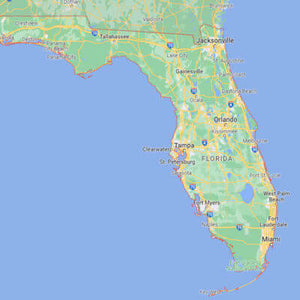
Sarracenia flava, also known as the yellow pitcher plant, has a large natural range that extends from southern Alabama to the coastal plains of southern Virginia, North Carolina and South Carolina.
Many Sarracenia flava clones owned by collectors have location data recorded against them. This location may refer to where the plant was originally collected from or from where seeds were harvested. This data is important from a conservation point of view.
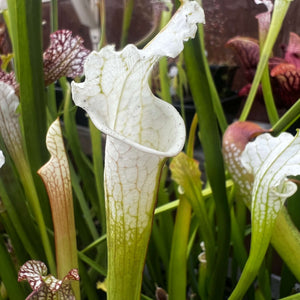
There aren't many anthocyanin-free (no red) forms of Sarracenia Flava in cultivation and this particular clone is a beauty.
MS-F3
Sarracenia flava f. viridescens (Shallotte, Brunswick County, North Carolina)

 Sold out
Sarracenia flava var. ornata - Maroon Throat (Apalachicola National Forest, Florida) MK-F88
Sold out
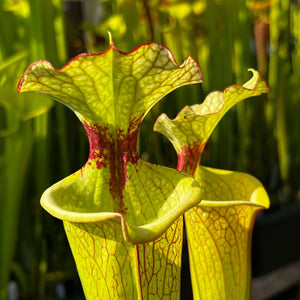
Sarracenia flava var. ornata - Maroon Throat (Apalachicola National Forest, Florida) MK-F88
Arguably one of the best Sarracenia flava var. ornata available. This is a sturdy, vigorous Sarracenia flava with strong colouration making it a st...
View full detailsCuprea translates from Latin to mean 'copper'. It's easy to see why this name has been given to this variety of Sarracenia flava, the operculum (li...
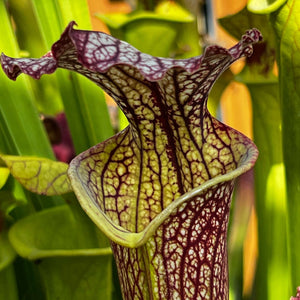
View full detailsA nice example of a Sarracenia flava var. ornata from Florida. As per the varietal name 'ornata', this Sarracenia flava displays ornata red veins t...
View full detailsJS-F35
A vigorous example of Sarracenia flava var. ornata from Virginia. The pitchers are the classic flava shape with generally fine red veination. For u...
View full detailsThis vigorous clone of Sarracenia flava is a great plant if you want an easy-to-grow, nice-sized, and hard-as-nails Sarracenia flava var. flava. Th...
View full detailsThis is an attractive clone of copper-top Sarracenia flava. Relatively fast-growing, this flava can make a great display if left to fill a large po...
View full detailsThe pitchers of this impressive Sarracenia flava var. flava are well-formed and large, usually about 75cm tall or sometimes more. The upper part of...
View full details