
WhatsApp
Send us a message
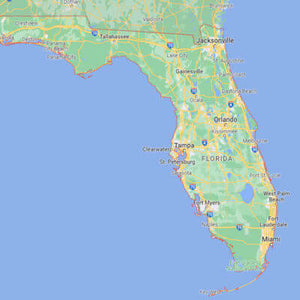
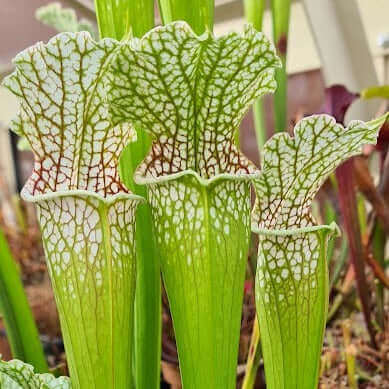
Sarracenia leucophylla is endemic to the warmer Southeastern United States primarily along the Gulf Coast. It is naturally found growing in North Florida, across Alabama, Georgia and Mississippi. There may be introduced populations growing in other states.
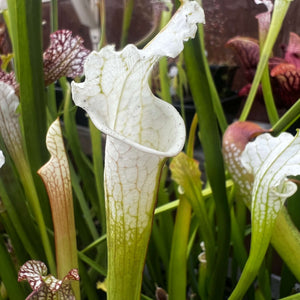
There are two primary varieties of Sarracenia leucophylla; the species-typical Sarracenia leucophylla var. leucophylla and the white-topped leucos Sarracenia leucophylla var. alba (including the famous 'Hurricane Creek White').
MK-L151
Sarracenia leucophylla 'Mont Blanc' started out as a batch of seed collected in Walton County, Florida, by George Mac Kay. Thibault Barin sowed the...
View full detailsMK-L18
Sarracenia leucophylla L104 X Hurricane Creek White
MK-L48A
The 'Hurricane Creek' cultivar name can be applied to Sarracenia leucophylla var. alba clones, or their seeds, that were found at the Hurricane Cre...
View full detailsSarracenia leucophylla var. leucophylla (Gas Station Site, Perdido, Alabama)
The pitcher of this species displays typical colour, size, and shape for the Sarracenia leucophylla species. The flower features an abundance of un...
View full detailsThe 'Hurricane Creek' cultivar name can be applied to Sarracenia leucophylla var. alba clones, or their seeds, that were found at the Hurricane Cre...
View full detailsMK-L101, JS-L12
MK-L4
Sarracenia leucophylla var. leucophylla - Purple & White Giant (Rt71, Altha, Calhoun County, Florida)
This plant is a rare, anthocyanin-free form of Sarracenia leucophylla. It originates from a specific location near Perdido in Alabama, USA. The 'vi...
View full detailsSarracenia leucophylla var. leucophylla (Citronelle, Alabama)