
WhatsApp
Send us a message
Anthocyanin-free Sarracenia, also known as antho-free, lack all red pigmentation giving them a crisp, electric-green look!
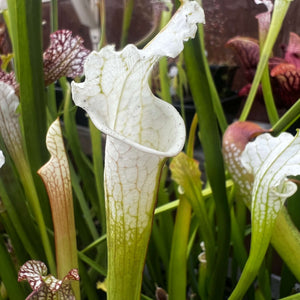
Sarracenia alata var. alata f. viridescens (Washington County, Alabama) is an anthocyanin-free form of the pale pitcher plant. Unlike typical alata...
View full detailsThis is a really nice form of Sarracenia psittacina. The viridescens forms are anthocyanin free which means they do not contain any of the red pigm...
View full detailsHere's an unusual, but attractive, Sarracenia hybrid! This bright green hybrid is a cross of 2 anthocyanin-free (no red) parents in Sarracenia × gi...
View full detailsThis bright little Sarracenia is the anthocyanin-free form of Sarracenia rubra subsp. gulfensis. This means that it contains no red pigmentation, m...
View full detailsSarracenia purpurea subsp. venosa var. venosa f. pallidiflora is a rare anthocyanin-free form of the southern purple pitcher plant. Stewart McPhers...
View full detailsSarracenia purpurea subsp. venosa var. burkii f. luteola
Sarracenia psittacina var. okefenokeensis f. luteoviridis (Sandy Creek Road, Bay County, Florida)
Sarracenia minor var. minor f. viridescens F2
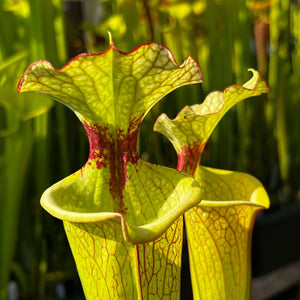
There aren't many anthocyanin-free (no red) forms of Sarracenia Flava in cultivation and this particular clone is a beauty.
Sarracenia flava f. viridescens 'Suspicion' is a well-known, all-green clone of Sarracenia flava that stands out in any collection. The only named ...
View full detailsSarracenia psittacina var. psittacina f. viridescens (Wewahitchka, Gulf County, Florida) is an unusual anthocyanin-free form of the parrot pitcher ...
View full detailsSarracenia flava f. viridescens (Shallotte, Brunswick County, North Carolina) is a rare anthocyanin-free form of the yellow pitcher plant. Originat...
View full detailsMK-RJ2, JS-RJ2
This plant is a rare, anthocyanin-free form of Sarracenia leucophylla. It originates from a specific location near Perdido in Alabama, USA. The 'vi...
View full details