
WhatsApp
Send us a message
MK-H258
Sarracenia 'Sky Watcher' is a selected clone believed to originate from the complex hybrid Sarracenia umlauftiana. Its parentage combines S. courti...
View full detailsMK-H225
The parentage of Sarracenia 'Saxapahaw' is a mystery, though its characteristics suggest ancestry from Sarracenia flava var. atropurpurea and Sarra...
View full detailsSarracenia 'Mary Cheek' is a striking Sarracenia hybrid, bred by Roy Cheek and named after his wife, Mary. As a Sarracenia × mitchelliana, it combi...
View full detailsIs this the best-looking Sarracenia oreophila around? It's certainly a contender! Originally from the Sand Mountain plateau in Northwest Georgia, t...
View full detailsMK-L4
Sarracenia 'Ellie Wang' is a beautiful Sarracenia cultivar that Mike Wang developed in the San Francisco Bay Area. He named the plant for his daugh...
View full details
 Sold out
Sarracenia flava var. ornata - Maroon Throat (Apalachicola National Forest, Florida) MK-F88
Sold out
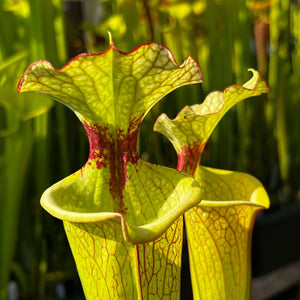
Sarracenia flava var. ornata - Maroon Throat (Apalachicola National Forest, Florida) MK-F88
Arguably one of the best Sarracenia flava var. ornata available. This is a sturdy, vigorous Sarracenia flava with strong colouration making it a st...
View full detailsThis lovely-looking Sarracenia hybrid takes some of the best qualities from both parents. The pitchers are velvety soft pubescent form from the Sar...
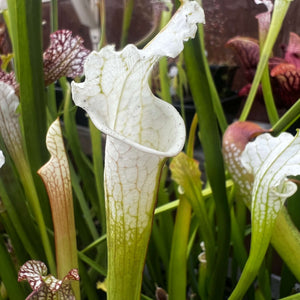
View full detailsSarracenia leucophylla var. leucophylla - Purple & White Giant (Rt71, Altha, Calhoun County, Florida)
A nice, vigorous form of Sarracenia × alava (Sarracenia flava X Sarracenia alata). Looks great if left to form a decent sixed clump.
Sarracenia × moorei OBH26 comes from a cross made by Oliver Bres of Sarracenia Addiction in France. He paired a large red-form Sarracenia × moorei ...
View full detailsSarracenia flava f. viridescens 'Suspicion' is a well-known, all-green clone of Sarracenia flava that stands out in any collection. The only named ...
View full detailsOne of the giants! The 'Chipola Giant' Sarracenia purpurea subsp venosa var. burkii (or Sarracenia rosea if you prefer) clones are real show-stoppe...
View full detailsMK-H175
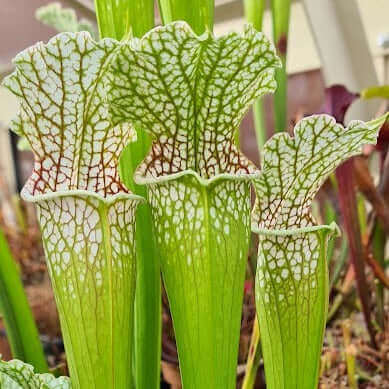
This plant is a rare, anthocyanin-free form of Sarracenia leucophylla. It originates from a specific location near Perdido in Alabama, USA. The 'vi...
View full detailsSarracenia purpurea subsp. purpurea (Wareham Forest, Dorset, UK) represents a naturalised population established in southern England. Originally na...
View full detailsSarracenia 'Vogel' is a well-known Sarracenia cultivar known for its robust, bulging pitchers and distinctive colouration. The pitchers reach nearl...
View full detailsSarracenia × soperi (Sarracenia alata – Red Lid X Sarracenia flava var. ornata) is a classic hybrid by Adrian Slack. It combines the upright struct...
View full detailsFormally known as Sarracenia 'Barbapapa', this is the first Sarracenia to join the Sarracenia House collection! Some say it's the one that started ...
View full detailsSarracenia 'Lynda Butt' is a hybrid crafted by the renowned carnivorous plant pioneer Adrian Slack in the UK. This beautiful cultivar is named in h...
View full detailsSarracenia leucophylla var. leucophylla (Citronelle, Alabama)
This is an attractive clone of copper-top Sarracenia flava. Relatively fast-growing, this flava can make a great display if left to fill a large po...
View full details