
WhatsApp
Send us a message
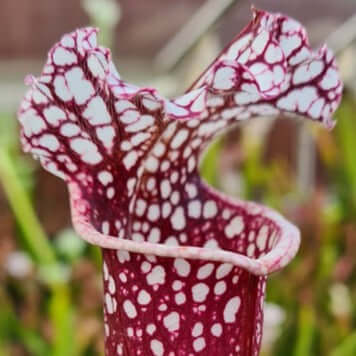
From the 1990's came a beautiful Sarracenia leucophylla hybrid (Sarracenia leucophylla x Sarracenia x willisii) created by Mark Edwards of New Zeal...
View full detailsSarracenia × moorei 'Leah Wilkerson' X × moorei 'Adrian Slack' - Laurens Eggen B Clone
MK-H49E
Here's a deservedly famous cultivar of Sarracenia × exornata that we believe is essential for any Sarracenia collection! You may come across this p...
View full detailsSarracenia 'Ann Mundy'
Sarracenia × moorei 'John David King'
Sarracenia × moorei 'Elizabeth Aydon'
MS-SH001
MK-H298
Sarracenia ‘Alucard’ is a fascinating and mysterious carnivorous plant that is sure to capture anybody's attention. This complex hybrid of Sarracen...
View full detailsSarracenia × areolata 'Langford Williams' is a registered cultivar of a hybrid between Sarracenia alata and Sarracenia leucophylla. The plant origi...
View full detailsMK-H262
This is one wild Sarracenia! With its large, skewiff mouth and flared hood Sarracenia 'Asbo' is sure to stand out in any collection. In the UK, ASB...
View full detailsNational collection description: MK-H232 Sarracenia x ‘Asuka No. 4’ (MH 2010)
Named after Matt Soper's (Hampshire Carnivorous Plants) father, Sarracenia 'Barry Soper' is among the finest looking Sarracenia. The pitchers devel...
View full detailsAt first glance, you'd be forgiven for thinking this is a very pretty Sarracenia leucophylla and you'd nearly be right. It is in fact a hybrid of S...
View full detailsMK-H302
Sarracenia 'Black Knight'
Sarracenia × catesbaei 'Golden Eagle' is a hybrid pitcher plant. Like all Sarracenia × catesbaei, it results from a cross between Sarracenia flava ...
View full detailsIP-X08, JS-H11
Sarracenia 'Constence Healy' is a Stunning Sarracenia cultivar. It was developed by Nigel Hewitt-Cooper in 1999. He named it for his maternal grand...
View full detailsMK-H116
Sarracenia 'Dixie Lace' was created in 1993 at the University of North Carolina. One parent of this clone was a naturally occurring hybrid, known i...
View full detailsSarracenia 'Doreen's Colossus' is a majestic Sarracenia hybrid, celebrated for its colossal size and striking appearance. It originates from a cros...
View full details