
WhatsApp
Send us a message
MK-H362
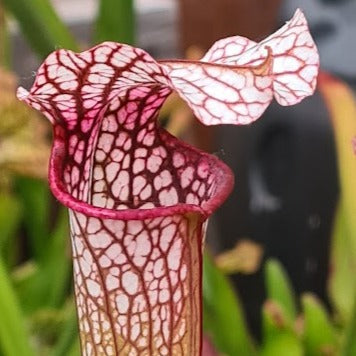
Although it has the appearance of a robust Sarracenia leucophylla, Sarracenia 'Giant Cotton' is actually a striking hybrid between Sarracenia leuco...
View full detailsJS-F130
MK-L34
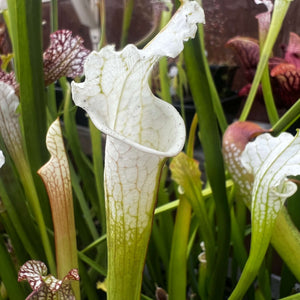
Sarracenia leucophylla var. alba White Top (Baldwin County, Alabama)
This plant is a rare, anthocyanin-free form of Sarracenia leucophylla. It originates from a specific location near Perdido in Alabama, USA. The 'vi...
View full detailsMK-L115
The 'Hurricane Creek' cultivar name can be applied to Sarracenia leucophylla var. alba clones, or their seeds, that were found at the Hurricane Cre...
View full detailsThe 'Hurricane Creek' cultivar name can be applied to Sarracenia leucophylla var. alba clones, or their seeds, that were found at the Hurricane Cre...
View full detailsThe 'Hurricane Creek' cultivar name can be applied to Sarracenia leucophylla var. alba clones, or their seeds, that were found at the Hurricane Cre...
View full detailsSarracenia leucophylla var. alba - No. 5 Christian Klein
MK-F149
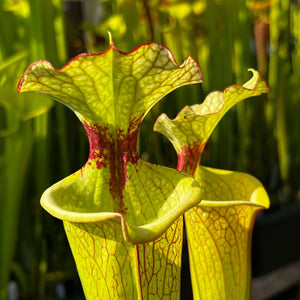
Sarracenia flava var. rubricorpora 'Roy Lancaster' is a beautiful cultivar selected by carnivorous plant expert Matt Soper. Named in honour of the ...
View full detailsThis is one really elegant Sarracenia × moorei and a favourite in the collection! As a × moorei this plant is a cross between Sarracenia flava and ...
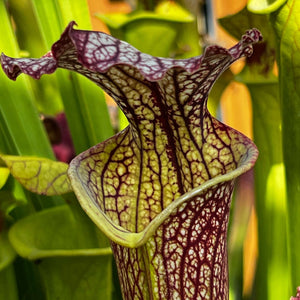
View full detailsThis Sarracenia purpurea subsp. venosa var. burkii (Sarracenia rosea) from Bay County, North Florida, is a large-growing Gulf Coast form with a cle...
View full detailsSarracenia 'Royal Ruby' is a striking natural hybrid of Sarracenia × moorei (Sarracenia flava X Sarracenia leucophylla), originally discovered in n...
View full detailsSarracenia 'Troll' is a striking cultivar with robust, upright pitchers that superficially resemble Sarracenia flava, but with a much heavier build...
View full detailsSarracenia 'True Blood' is an original hybrid from Adrian Slack. Its parentage is complex but shows influence from Sarracenia flava, Sarracenia pur...
View full detailsSarracenia purpurea 'Sorrow' is a unique cultivar with striking pigmentation differences from typical Sarracenia purpurea subsp. purpurea. It origi...
View full detailsSarracenia purpurea ssp. purpurea (Algonquin Provincial Park, Ontario, Canada)
Sarracenia × popei is a hybrid of S. flava and S. rubra. That offers a wide range of variability amongst plants that are S. × popei! Our popei prod...
View full detailsMK-PV41
A beautiful Michael King Sarracenia Hybrid with stunning pinks that change throughout the season! This hybrid was created by crossing a Sarracenia ...
View full detailsIntroducing the famous Sarracenia flava 'Goldie', a must-have for any Sarracenia collector. This flava boasts bright golden-coloured pitchers that ...
View full details